
The curriculum
A structured pathway, from first rally to competitive play.
Victory Pickleball Academy’s curriculum is built as a developmental pathway, not a one-time clinic. Every student, whether they’ve never held a paddle or they’re chasing a competitive edge, moves forward through a clear, professionally structured progression for grades 1–12.
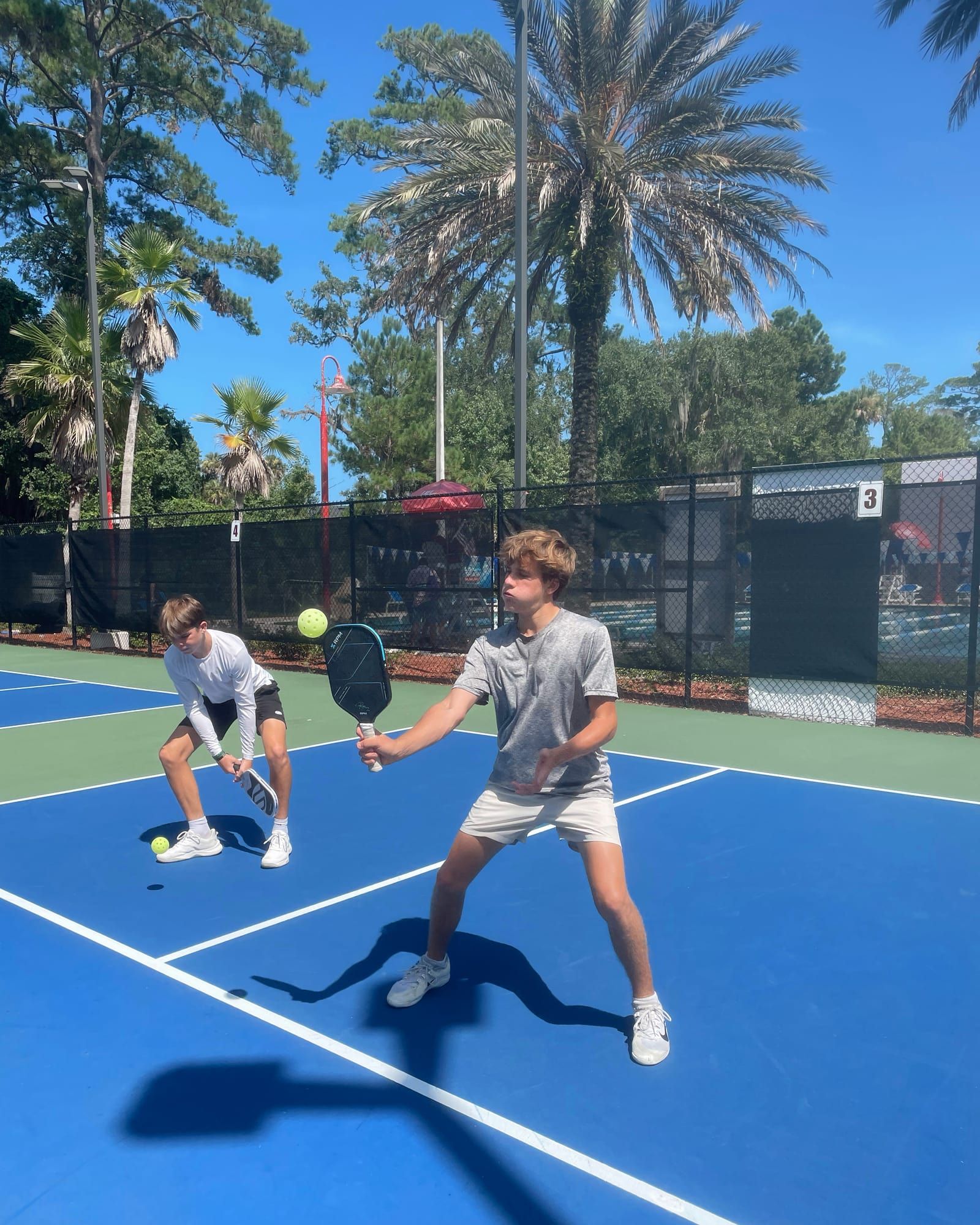
- Grades 1–12
- Beginner to advanced
- Doubles-first
- 60-minute sessions
We teach by playing, in pairs
Students learn through real play, not endless ball-feeding lines. Cooperative rallies come first, and coaches guide without over-coaching, so kids develop feel, decision-making, and confidence on the court.
Development is doubles-first.
Nearly all school and recreational pickleball is played two-on-two, so students learn positioning, partner movement, and on-court communication from the beginning rather than retrofitting them later.
The pathway
Three tiers, one progression. A student joins where they are and keeps moving.
-
Beginner
Grip, stance, and ready position, then forehand, backhand, serve, and return of serve. Court awareness and cooperative rallies come early, so students play real points fast.
-
Intermediate
Doubles positioning and the middle of the court: dinking consistency, transition-zone control, net play, partner movement, and the communication cues that make a team work.
-
Advanced
The shots that decide points: third-shot drops, resets under pressure, speed-ups and counters, court spacing, and tournament-style sessions with pathways toward competitive play.
Mastery, one skill at a time
The order every coach manual teaches in, and the order a student actually learns in.
-
Grip & ready position
A handshake grip, an athletic stance, and a flat paddle face. Control before power, from the first minute.
-
Forehand
The first real stroke: contact out front, paddle steady, eyes on the ball. Built through bounce-up control and partner feeds.
-
Backhand
The side most players avoid, taught early so it never becomes a weakness. Same cues, mirrored.
-
Serve & return
Weeks four and five. A consistent, legal serve and a returned ball are what turn drills into actual points.
-
Net play & dinking
Once the baseline game holds, players move up. Soft hands at the non-volley zone, patience, and the transition zone in between.
-
Rally & match play
Full court, traditional scoring, doubles partners, and organized matches. Everything before this exists to make this possible.
Beginners may use foam or indoor balls, shorter courts, and extra bounces, then advance to full court with traditional scoring and organized matches. Every stage is taught in doubles, because that is how school pickleball is actually played.
How it adapts by grade
The same pathway, pitched to the room it is taught in.
Grades 1–3
Play first
Oversized targets, shortened courts, and play-first games that build hand-eye coordination before technique.
Grades 4–6
Fundamentals
Game-based warm-ups, ball-control fundamentals, and small-court games keep younger players moving and engaged.
Grades 7–12
Match play
A faster on-ramp into rally progressions, doubles and singles play, and team-match structures.
Anatomy of a practice
Sixty minutes, eight blocks, opening with the day’s character word and closing with the VPA Huddle, built around comfort, contact, and confidence. Kids leave having warmed up, drilled, rallied, and played real points.
The structure is the same at every level — a beginner group and an advanced group run the same hour. That consistency is a coaching standard, not a shortcut. What changes is the work inside the blocks.
- 0:00–0:05
Welcome & character word
Players gather, and the coach introduces the day’s character word with a simple definition they understand. It frames everything that follows.
- 0:05–0:12
Warm-up
An athletic movement circuit — high knees, shuffle, backpedal — to get bodies moving. The cues stay simple: stay light, athletic stance.
- 0:12–0:20
Skill introduction
The day’s skill, demonstrated and broken down. In week one that means a handshake grip, a flat paddle face, and control over power.
- 0:20–0:32
First drill
Reps on the new skill: bounce-up control, forehand first, then alternating. Cues stay short — soft hands, eyes on the ball.
- 0:32–0:44
Second drill
The same skill under a little more pressure, or the next piece layered on top, so it holds up when the ball is moving.
- 0:44–0:52
Skill game
A cooperative game built around the day’s skill. Partners rally five to eight feet apart with a one-bounce rule, chasing a three-to-five-shot rally.
- 0:52–0:58
Live play
Real points on a short or full court, depending on the group. Coaches guide without over-coaching.
- 0:58–1:00
VPA Huddle
Everyone to center court. Review the day, revisit the character word, then close it out together — “Victory on three!” One! Two! Three! VICTORY!
Character, built into every practice
A 50-word focus system is woven into every session. Coaches introduce a word, connect it to on-court situations, reinforce it through play, and tie it to life beyond pickleball.
-
Week 1
Respect
-
Week 2
Effort
-
Week 3
Confidence
-
Week 4
Responsibility
-
Week 5
Patience
-
Week 6
Sportsmanship
Every coach on every court reinforces the same idea in the same week.
From the wider fifty
- Effort
- Grit
- Respect
- Teamwork
- Sportsmanship
- Next Play Mentality
Big goals are accomplished one day at a time.
Learn one new skill. Encourage one teammate. Improve one habit, then come back tomorrow and do it again.
Formats & length
Three ways to run it, scoped to your schedule.
Semester
12–16 weeks
1–3 sessions per week. The core program.
Pilot
6–8 weeks
A low-commitment way to evaluate fit.
Camps & clinics
Seasonal
Options including holiday and summer camps, plus small-group and weekend clinics.
Ready to see the program?
We’ll walk your team through the pathway, the session structure, and how it fits your schedule.