Victory Pickleball Academy

Pickleball 101

How pickleball works

New to the fastest-growing sport in the United States? Here’s everything a parent needs to know about how pickleball is played — the rules, the court, and why kids across Northeast Florida are picking it up so quickly. Five minutes and you’ll be able to follow every rally.

The rules, in plain English

Pickleball has a short rulebook by design. These seven ideas cover almost everything you’ll see in a youth session.

What pickleball is

A paddle sport that blends tennis, badminton, and table tennis. Players use solid paddles and a lightweight plastic ball with holes, on a court much smaller than a tennis court. It can be played as singles or doubles — youth programs mostly play doubles.

The underhand serve

Every rally starts with an underhand serve struck below the waist, hit diagonally to the opposite service court. No overhead smashing to start a point — which is exactly why beginners can serve successfully on day one.

The two-bounce rule

After the serve, the ball must bounce once on each side before either team can volley it out of the air. This one rule slows the start of every rally, creates longer points, and gives new players time to get into position.

The kitchen (non-volley zone)

The 7-foot zone on each side of the net is called the kitchen. Players may not volley the ball while standing in it. The kitchen prevents net-hogging smash battles and rewards touch, placement, and patience over raw power.

Scoring: to 11, win by 2

Games are typically played to 11 points, and you must win by 2. In traditional scoring, only the serving team can score a point. Players call the score out loud before each serve — a habit kids pick up quickly.

Faults

A rally ends on a fault: the ball lands out of bounds, goes into the net, a player volleys from inside the kitchen, or the two-bounce rule is broken. A fault by the serving team hands over the serve; a fault by the receiving team gives the servers a point.

The court: smaller than tennis

A pickleball court is 20 feet by 44 feet — the same size for singles and doubles, and roughly the footprint of a badminton court. The net is slightly lower than a tennis net: 36 inches at the sidelines, 34 inches at the center.

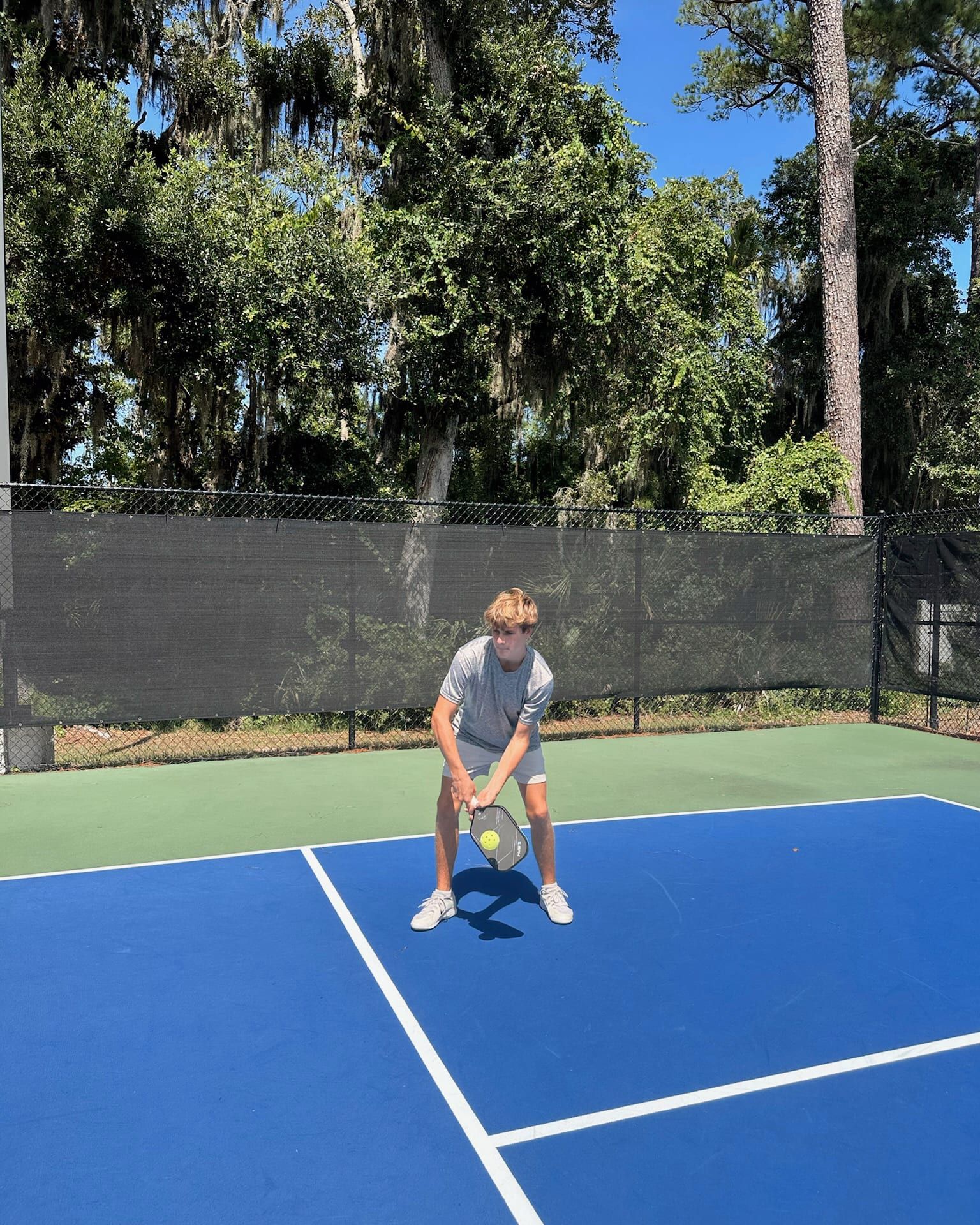
Built for kids. Practical for schools.

Why kids pick it up fast

Light paddles, a slower plastic ball, a small court, and an underhand serve mean the sport meets kids where they are. Most kids are rallying within their very first session — success comes early, so they stay engaged.

Why schools love it

Low equipment cost, a small footprint — courts fit inside a gym or on existing blacktop — and every athletic level can play together in the same session. It works as PE enhancement, an elective, or after-school programming.

Want to go deeper?

We keep this page simple on purpose. For the full official rulebook or a place to try the game as a family, these two resources are the best on the internet.

The official rules

USA Pickleball is the sport’s national governing body. Their guide covers every rule, the history of the game, and how to play.

Find a local court

Want to try it this weekend? Pickleheads keeps an up-to-date directory of public pickleball courts around Jacksonville and Northeast Florida.

Now that you know how it works…

See how Victory Pickleball Academy turns these basics into a structured youth program — coordination, confidence, and character, taught right at your child’s school or co-op.

School or co-op leader? See how VPA works for schools